Originals November 2020(2)


JF Original Problems | November, 2020(2)

The judge of JF-2020/II: Hans Gruber.
The judge of Retro & PG problems 2019-2020: Vlaicu Crișan

Coming soon: nobody in the waiting list…

  • (30.11) No.1564 (hs#4) János Csák (Hungary) & Aleksey Oganesjan (Russia). Attractive sacrifices lead to ODT “model checks” and model mates.
  • (28.11) No.1563 (h#4 ; Grasshopper) Niels Danstrup (Denmark). An interesting coincidence about the numbers: the previous problem by Niels was No.1553 on the date 28.10!
  • (26.11) No.1562 (h#4 ; Functionary Chess) Oleg Paradzinskij (Ukraine). Warm welcome to Oleg!
  • (24.11) No.1561 (h#2 ; HurdleColourChanging pieces, Lion, Rook-Lion, Rose-Lion) Michal Dragoun (Czech Republic). The problem is not computer-tested – I found firstly geometrical pattern and then I discovered, that neither Popeye nor WinChloe are able to test Andernach roselion…(Author). Important to note two different names for the same property: Andernach hoppers = HurdleColourChanging pieces.

Animated diagrams use Py2Web by Dmitri Turevski and WinChloe‘s graphics, Christian Poisson


Going Forward to Light and Order!

Going Forward
to Light and Order!

by Shankar Ram

Our chess problem field is not gaining as many new followers as it should. There is a competition for ways to spend leisure time: various other board and video games – most of them available online, as well as the old ways like music, movies, serials, sports – again mostly online. Also, the regular game is experiencing a boom, with more OTB and online tournaments. But here too, players are less interested in chess problems, than before.
In this atmosphere, we should try to make our hobby as attractive as possible for newcomers. The biggest area in chess problems is the category of fairy chess. Here, more and more new forms are being invented. The easy availability of chess problem solving software is probably helping in this. But this has created a big obstacle for the newcomer, who might well be scared away by the plethora of incomprehensible terms under the diagrams!
Therefore, this project is an attempt to provide an easy and helpful way for a newcomer to find the definition of an unfamiliar fairy element, as well as some additional information about its history, popularity, software supporting this element and of course, some carefully selected example problems which bring out the characteristics of the element.

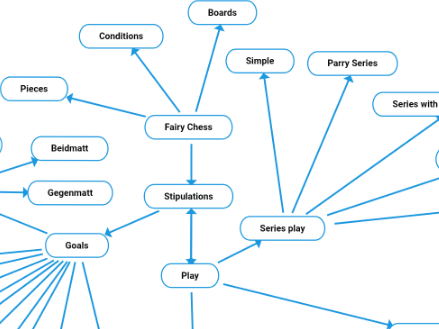
In the process of this project, we need to classify the various elements into groups and sub-groups, along with linkages between similar elements – in short, produce a taxonomy or knowledge organisation of fairy chess elements. This will aid understanding, meet the human need for orderliness, and help to check whether a particular element is already existing.

Of course, various sources are available online, many of which meet the above objectives. These have been used as the basis or foundation for this project. All of them have been listed and acknowledged. However, all of them have some shortcomings in terms of completeness, being up-to-date, clarity, example problems and organisation. Our project is an attempt to address all these shortcomings.

We welcome all comments and suggestions!


A great work to classify fairy elements has been already done mostly by Shankar Ram and Chris Tylor! (Julia)

Originals November 2020

JF Original Problems | November, 2020

The judge of JF-2020/II: Hans Gruber.
The judge of Retro & PG problems 2019-2020: Vlaicu Crișan

Coming soon: nobody in the waiting list…

  • (16.11) No.1560 (PG 9 ; Nanna Chess) Gregor Werner (Germany). Warm welcome to Gregor!
  • (15.11) No.1559 (s#7 ; Circe) Ivan Bryukhanov (Ukraine). Welcome back after 8 years break! 😉
  • (15.11) No.1558 (PG 2.5, 7-fold checkmate ; Add pieces, KoBul Kings, Make&Take) Pierre Tritten (France). Just an empty board?! (no animation)
  • (15.11) No.1557 (hs#2 ; Grasshopper, PAO, VAO) Georgy Evseev & Boris Shorokhov (Russia). Welcome to solve!
  • (06.11) No.1556 (hs=3 ; AntiCirce) Gábor Tar (Hungary). „Anticice pin” on the same square.
  • (06.11) No.1551.1 (ser-s#21 ; Circe Rex Inclusiv) Dirk Borst (Netherlands). Correction to No.1551: bPe7 is added to correct the cook found by Arno Tüngler and Kjell Widlert
  • (06.11) No.1525.2 (h=10.5) Anatoly Stepochkin & Sergey Shumeiko (Russia). Improvement to No.1525.1: same idea, but nicer solution.
  • (03.11) No.1555 (hs#3.5) János Csák & Gábor Tar (Hungary). Warm welcome to János!
  • (02.11) No.1554 (hs#4) Vitaly Medintsev (Russia). ODT model mates and something more to discover…

Animated diagrams use Py2Web by Dmitri Turevski and WinChloe‘s graphics, Christian Poisson


Fairy Classification, step 1: sources and more…

Fairy Classification project: step 1

Our Fairy Classification project has started, motivated by the great enthusiasm and good will of Chris Tylor and Shankar Ram! Now our small group is moving from the Preliminary questions  to the next steps. The main ideas of this post are :

  • to inform everybody what we currently do;
  • to get your comments/suggestions about the current steps;
  • to involve more members to our working team.

On this first step we’re very grateful to:

If anybody still feels himself enthusiastic about our project – please, join us! Your suggestions and info about sources, classification, fairy definitions, historical facts, etc, may help a lot!